
The Tightrope
30 March 2026Balance and stability
Balance is one of those things you don’t think about until it’s gone. It ties together muscle strength, proprioception, coordination, and even cognition. When it fails, the consequences can be fast and serious. The Tightrope tests your ability to hold your ground when the ground isn’t making it easy.
THE SCIENCE
This one is blunt: in a 2022 study published in the British Journal of Sports Medicine, middle-aged and older adults who couldn’t stand on one leg for 10 seconds had an 84% higher risk of dying over the next seven years. The reason is as straightforward as it sounds. Falls are one of the leading causes of death and disability in older adults, and a broken hip carries roughly a 20-30% one-year mortality rate, not from the break itself, but from the immobility that follows. A 2024 study from Mayo Clinic Proceedings identified single-leg balance as the single best indicator of neuromuscular aging, declining faster than grip strength, walking speed, or knee extension force. Your non-dominant leg loses about 2.2 seconds of balance per decade.
The Trial
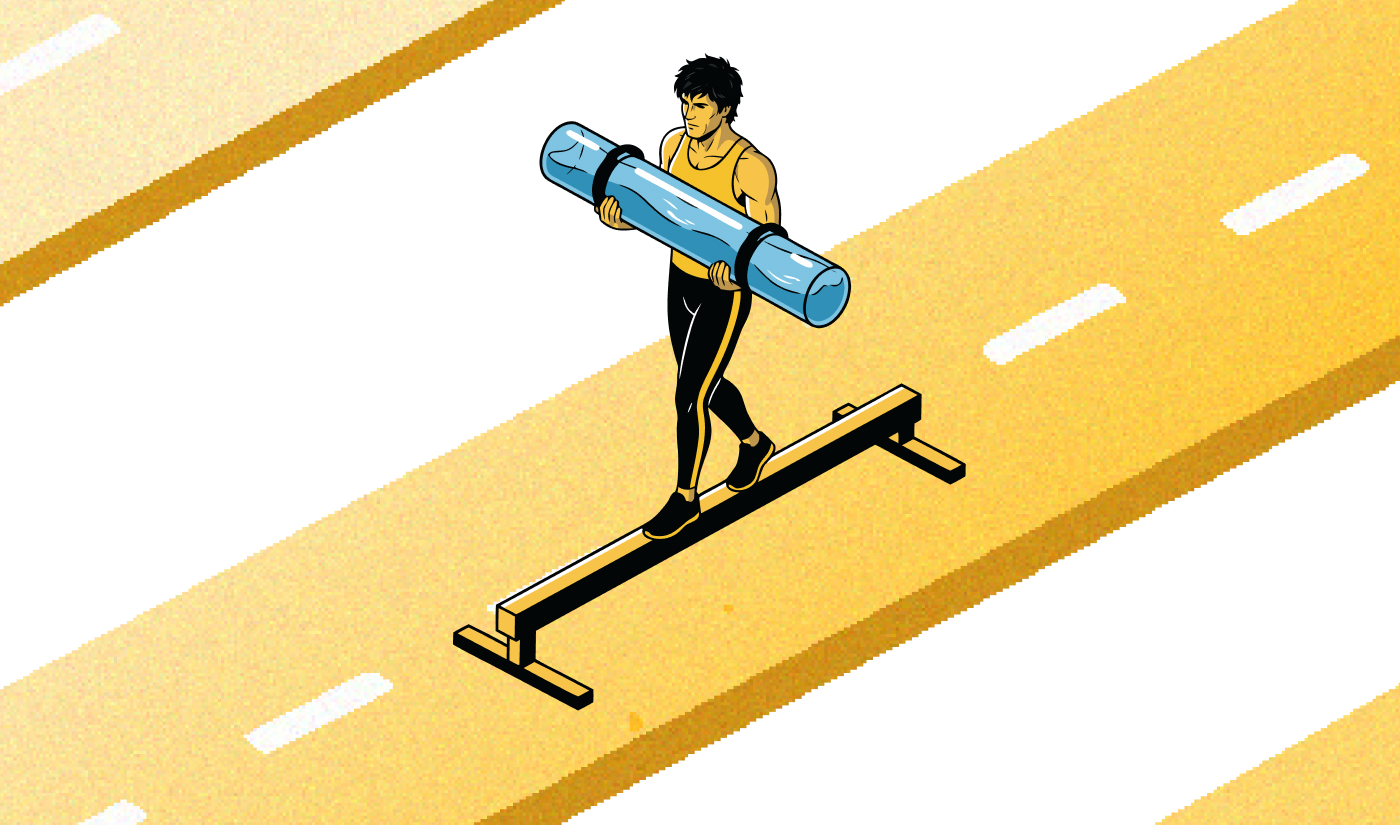
For The Tightrope, you’ll find yourself on a 12-foot low beam, walking forward and then backward while carrying a water-filled tube in a front rack position. Step-offs send you back to the start. Your score is a function of the maximum continuous distance covered in the time allowed.
HOW TO TRAIN
Honestly? Just practice. Stand on one leg while you brush your teeth. While you’re on a phone call. While you’re waiting for the coffee to brew. Close your eyes to make it harder and challenge your proprioception. Research shows that lunges on both stable and unstable surfaces improve balance in middle-aged adults, so add those to your rotation too. Balance is one of the most trainable markers on this list, and one of the most neglected.